
Overview
Mission
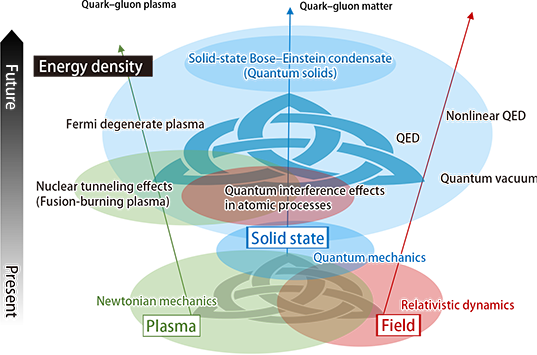
High-energy-density science, which deals with solids and plasmas in various extreme states of nonequilibrium open systems with high-energy densities produced by power lasers, is developing as an interdisciplinary field. However, there has been little cross-sectional discussion across various states of matter and fields.
In such a context, our project aims to explore various high-energy states of matter (solid, liquid, and plasma) achievable with lasers and to elucidate how their structures form and change under electromagnetic fields. In addition, it aims to identify similarities and common physical challenges among such high-energy states.
Research Content
This research aims to elucidate the structural transitions of matter with various high-energy density states and the underlying physics of those transitions across three domains in six research subjects. Using machine learning and artificial intelligence (AI) methodologies to investigate changes in the structural coherence (in frequency space) and dimensional characteristics (in real space) both within and between hierarchical levels, we seek to explore the similarities and universal principles governing structural transitions across diverse states.
A. High-Pressure Material Area
This research area targets structural phase transitions of solids and liquids and the processes of deformation, destruction, and reorganization.- A1
- Ultrahigh-pressure states of matter leading to new laser machining/processes as well as to the creation of novel materials.
- A2
- Ultrahigh-pressure states of matter related to planetary interiors, meteorite impacts, etc.
B. Space and Nuclear Fusion Plasma Area
This research area deals with plasma flow, turbulence, and instability associated with electromagnetic fields.- B1
- Plasma state related to laser nuclear fusion, including nuclear fusion burning.
- B2
- Plasma state related to cosmic rays, gamma-ray bursts, and other mysteries of the universe.
C. Plasma-based Particle Acceleration Area
This research area focuses on the formation and collapse of giant electron plasma waves and sheath fields, as well as on Coulomb explosions.- C1
- Plasma state with structures that can be used for electron acceleration (e.g., laser wake fields).
- C2
- Plasma state with steep electric field gradients leading to the production of high-energy ions.
Human Capacity Development
In this program, teams centered around early career researchers and graduate students will use existing international collaboration networks and liaison offices, as well as lead international collaborative research, in anticipation of larger-scale Grand Alliances. In addition, with the implementation of the following human capacity development programs, global talent who can play an active role on the world stage and lead the world will be nurtured.
Early Career Researcher and Graduate Student Exchange Program
- Long-term exchange program for early career researchers
(2 years) - Mid-term exchange program for doctoral students
(6 months) - Short-term exchange program for master’s and doctoral students and early career researchers
(3 months)
Supporting Professional Independence of Early Career Young Researchers: TASU Program
-
Training and Practice Program (T)
Practical education on conducting joint research abroad, support for planning international joint research, and training on how to prepare proposals and applications to obtain competitive funding, external funding, and machine time. -
Academia Startup Program (AS)
International collaborative research projects planned by early career researchers and graduate students are selected and supported through a competitive process, and the formation of international collaboration networks is also supported. -
Frontier Seminar U30 (U)
Regular (monthly) remote international collaborative seminars and annual or biennial summer and/or winter schools.